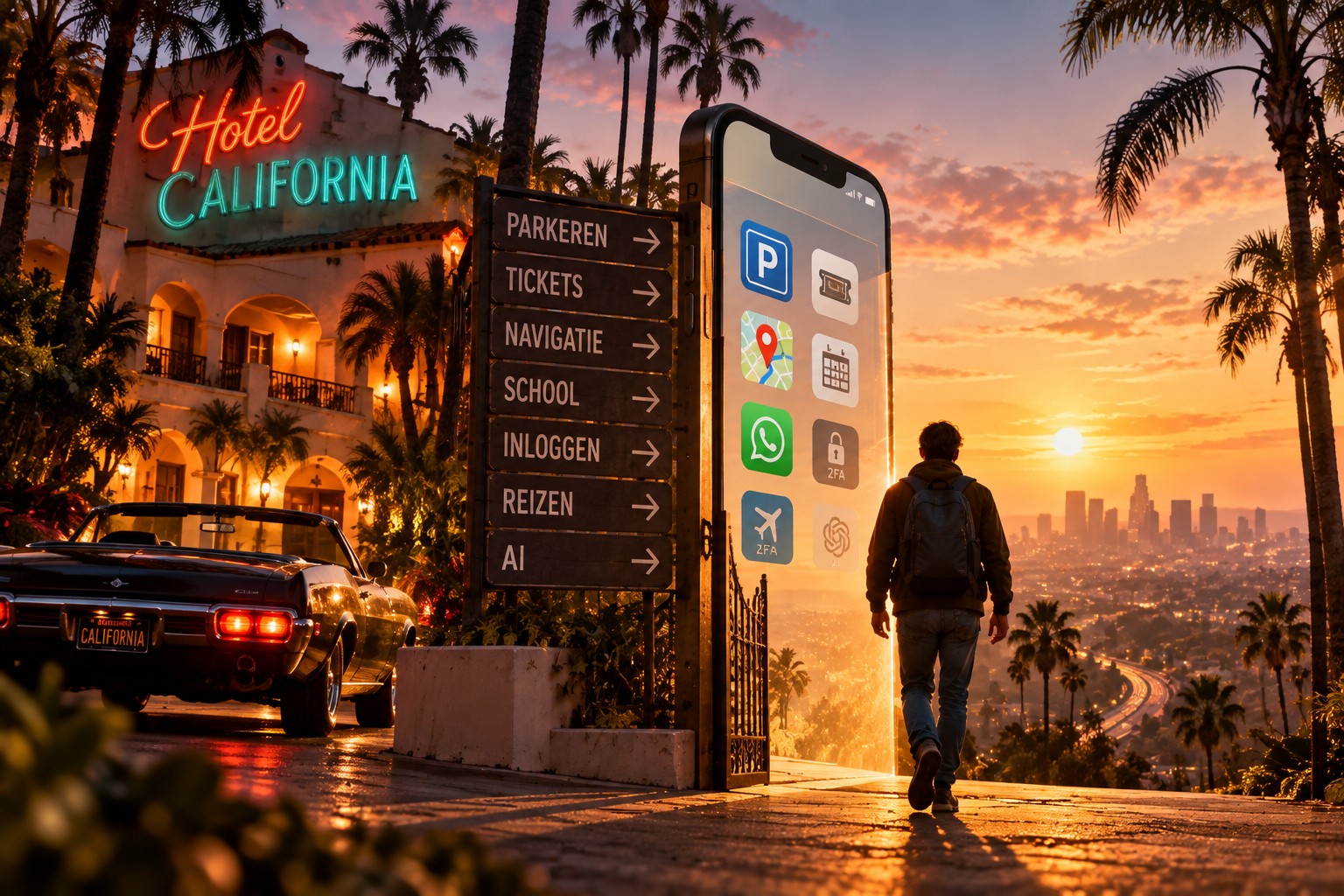
Sometimes an old song lyric suddenly seems written for a time that did not yet exist.
In 1976, the Eagles sang in Hotel California:
“We are all just prisoners here, of our own device.”
Almost fifty years before we would all be walking around with a smartphone in our hands.
A coincidence, of course.
By of our own device, they did not mean our phones. It meant something closer to being trapped in something of our own making.
But put that sentence into today’s world.
It becomes almost uncomfortably literal.
Try leaving your smartphone at home
Not on a walk in the woods. Just on an ordinary Tuesday.
You want to park. Get your phone.
You go to a concert. The ticket is on your phone.
You drive somewhere. Navigation.
Your child wants to know which lesson has been cancelled. The timetable is in an app.
You want to log in on your laptop. Get your phone to prove you are you.
We regularly say we want to depend less on our smartphones. We turn off notifications, set screen-time limits and put our phones away during meals.
Meanwhile, we are building a world in which that same phone becomes increasingly difficult to put away.
The smartphone stopped being just the device on which we watch too many videos a long time ago. It has gradually become a key to everyday life.
And now AI joins in
Perhaps AI will actually make things better.
Imagine no longer having to open five apps to arrange something. I simply say:
Arrange parking for the next two hours.
What time does my daughter need to be at school tomorrow?
Plan the best route to the concert, find out where I can park and have my ticket ready.
Perhaps that will actually reduce our screen time.
No menus. No endless searching. No five different apps. No filling in forms with information a system already knows.
The technology fades further into the background.
That sounds attractive.
But what are we handing over in return?
To do this for me, AI needs to know more and more about me. Where I am. Where I am going. What is in my calendar. Which accounts are mine. What matters to me.
And AI must be able to do more than see information. It must also be allowed to do things on my behalf.
Start my parking session. Make an appointment. Prepare a payment. Fill in a form. Perhaps eventually even make choices the system thinks suit me.
That changes the question.
With the smartphone, the question was still:
Am I using the device, or is the device using me?
With AI, that question becomes more complicated:
Am I using AI, or have I already given AI permission to act on my behalf?
And perhaps more fundamentally:
Where does convenience end and outsourcing my own judgement begin?
Less screen time does not automatically mean more freedom
This need not be a gloomy story.
Perhaps AI is precisely the technology that frees us from some of the digital hassle we have built up over the years.
Fewer screens. Fewer apps. Less searching. Less administration. More time for other things.
But less visible technology does not automatically mean more autonomy.
Perhaps we need to think about more than everything AI can do for us. We also need to keep consciously choosing what we want to continue doing, knowing and deciding ourselves.
Because convenience has a strange quality.
What feels good to outsource today can feel strange to do yourself tomorrow.
Navigation did not forbid us from finding our own way. We simply started doing it less.
AI could do the same with writing, searching, remembering, planning and, perhaps eventually, judging.
And then that almost fifty-year-old sentence takes on another meaning:
“We are all just prisoners here, of our own device.”
Perhaps the most important question is not how much technology we use.
But how much scope for action we retain as that technology can do more for us.
What would I gladly hand over?
And what do I want to keep doing myself, precisely because outsourcing it is becoming so easy?