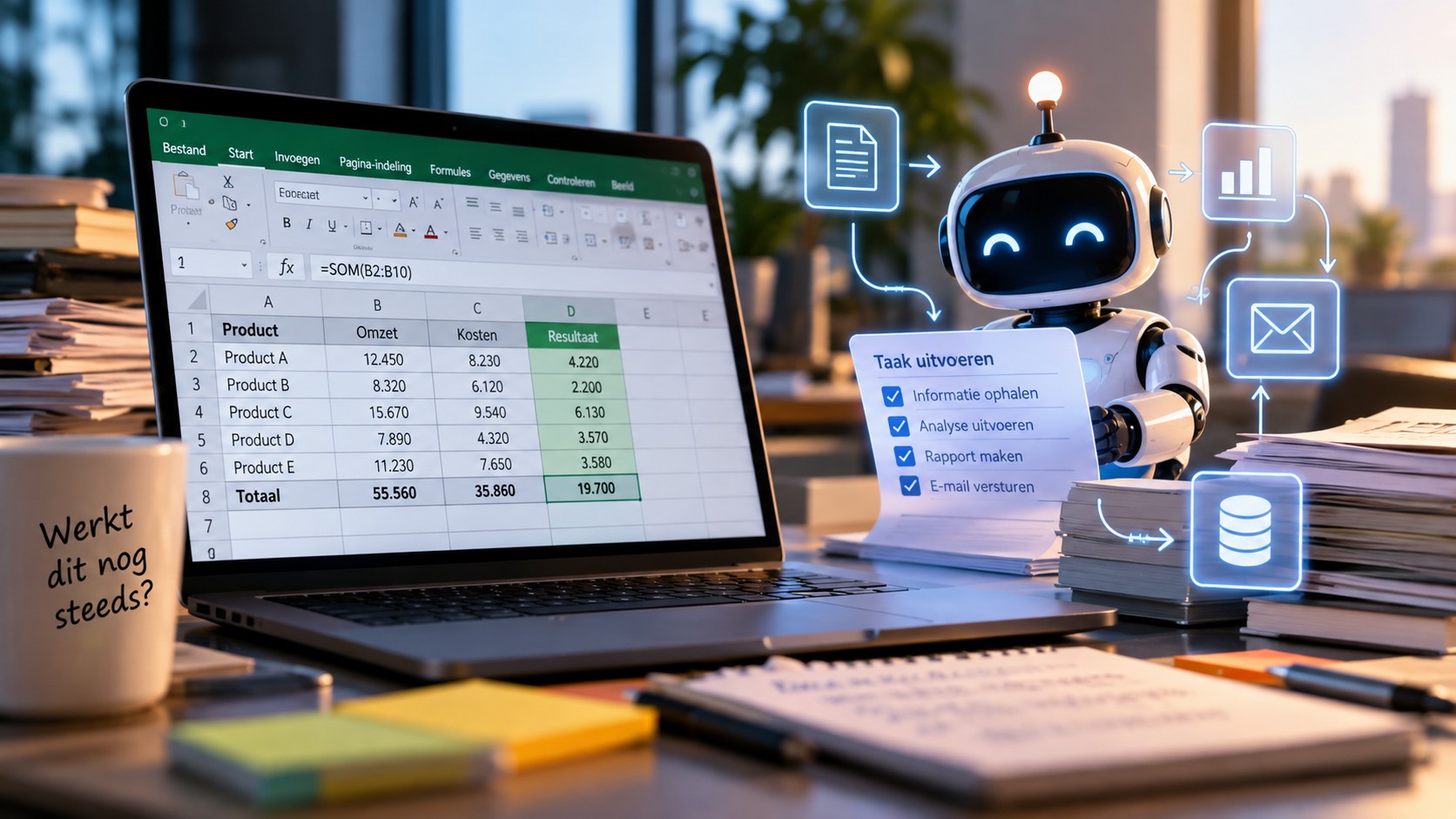
We did not need to understand Excel fully before starting to use it on a massive scale. AI will probably be no different. Only this time, the software is getting more scope to act on its own.
Almost everyone who works in an office knows Excel.
But how many people know Excel really well?
My own knowledge is certainly limited.
Most of us simply learned as we went along. A colleague shows you how a formula works. You adapt an existing file. You look up a function. Another sheet gets added. Then another.
And most of the time, that works fine.
Until that spreadsheet suddenly becomes important.
It contains dozens of formulas. Several people have worked on it. There are links to other files. Perhaps a few macros.
Nobody knows exactly how the whole thing works any more.
But every month it produces a number.
And we use that number.
I thought about this this week while learning more about AI agents.
Because something similar seems to be happening with AI.
Most people do not learn AI from a handbook either. We simply start.
First, ask a question. Then have it write a text. Summarise a document. Analyse data. Perhaps write some code.
Before you know it, AI has become part of your daily work.
That need not be a problem.
We constantly use technology we do not fully understand technically. I do not need to know exactly how ABS works to drive safely. And I do not need to know Excel’s source code to build a good spreadsheet.
Full technical understanding is probably not the right standard.
The more interesting question is whether I understand enough about what I am asking the technology to do.
And that is where AI changes something.
In principle, a spreadsheet does what we have built into it. Of course, that can go seriously wrong. An incorrect formula in a financial model, production schedule or quality report can have major consequences.
Excel is certainly not harmless.
And with macros, links and automation, a spreadsheet can already trigger actions.
But AI agents add something else.
Within an assignment, they can decide for themselves which intermediate steps are needed.
Gather information. Modify a file. Write code. Use another system. Perhaps send a message or start a process.
So the question shifts from:
Can I trust the result?
to also include:
How much scope am I giving this system to act independently?
I see that as a fundamental difference.
You could argue that users therefore need better training first.
AI literacy. Training. Procedures. Governance.
All useful.
But I do not believe we will wait until everyone understands AI, software development, cybersecurity, privacy and compliance.
We did not do that with Excel either.
And perhaps we do not have to.
People learn by using things. We try something. It works. We make mistakes. A colleague shows us a better way. Gradually, we gain experience.
That is not irresponsible.
To a large extent, it is simply how people learn.
It would even be strange to require every user to become an expert before being allowed to work with AI.
But that does not put all responsibility on the technology companies.
The supplier builds the system.
The organisation decides what it is used for.
And the user helps determine how they work with it.
Those responsibilities are different.
An agent that collects three news stories every morning is different from one with access to customer data, email, financial systems or a production environment.
Perhaps the AI’s intelligence is therefore not the most important measure of risk.
The scope we give it to act is at least as important.
And perhaps that is precisely where an opportunity lies.
Suppose we design AI agents differently from the outset than many spreadsheets have ended up.
With clear permissions. Visibility into what an agent has done. Limits on which systems it may use. Human intervention when a decision really matters.
An AI agent might eventually be easier to control than the spreadsheet people have been adding sheets to for fifteen years, where nobody remembers why cell H174 is so important.
Perhaps that is the real lesson of Excel.
People should not have to understand technology fully before using it.
But a useful tool can quietly become important.
With AI agents, we already know that.
So perhaps this time we should think about the boundaries before nobody knows exactly how the whole thing works any more.