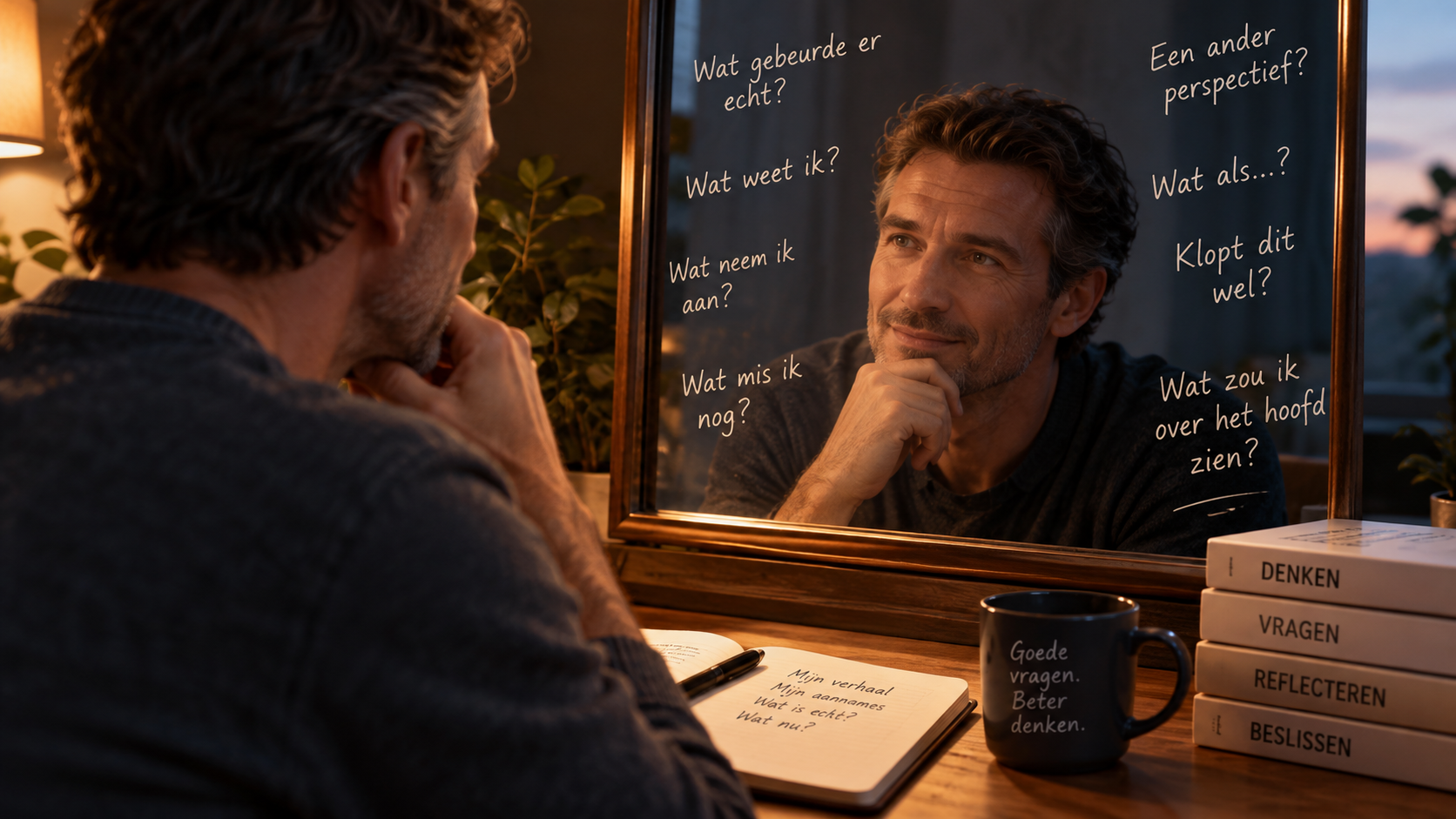
I now also use AI for daily self-reflection. I discuss my experiences of the day with a custom GPT: work, home, sport, things that went well and things that stayed with me.
Not to tell me what to do, but to complement my thinking. To see connections, organise my thoughts and occasionally receive a question I had not thought of myself.
Because I do this regularly, quite a lot of context is available. That makes the conversations more personal and often surprisingly valuable.
But recently, something small happened.
I mentioned enjoying a meal at home. My GPT casually assumed that my wife had prepared it for me.
Entirely plausible.
Except it was not true.
I laughed. But it revealed something.
AI can have lots of context and still not know what actually happened. Information was missing, and the model filled the gap with something that sounded logical.
Context helps. But context is not reality.
Where are you agreeing with me too easily?
We regularly hear that AI tells you what you want to hear.
There is a risk in that. At the same time, I choose which context to provide, how to describe a situation and which question to ask. My own assumptions may already be in my question before AI has produced a single word.
That is why I now try something different with important questions.
I let AI think with me first. Then I deliberately pause before treating the answer as a conclusion.
I ask a second question:
Where are you agreeing with me too easily? What assumptions are we making? What are we missing? What would someone with a different perspective say?
I call this The Mirror.
It regularly produces a more interesting conversation.
But there is a trap here too.
The AI that built my first line of reasoning is the same AI that then criticises it. A critical second prompt is not an independent second opinion.
So eventually I try to step outside AI again:
What do I still need to observe, verify, look up or discuss with someone before I act?
Not my thinking, but my judgement
Initially, I expressed my starting point as:
AI complements my thinking. It does not take over my thinking.
But on closer inspection, that is too simple as well.
Why should I not outsource thinking tasks to AI?
AI may organise information. Generate hypotheses. Find counterarguments. Compare documents. Develop scenarios. Perhaps it can perform some forms of thinking better or faster than I can.
The more important boundary lies elsewhere:
I can outsource thinking tasks to AI, but I do not want to outsource my judgement without noticing.
This now feels like an important distinction to me.
And then there are agents
The same applies to the current interest in AI agents.
The promise is attractive: put agents to work and become more productive.
But here too, I want to start with a different question:
What am I actually trying to achieve?
First the goal. Then the process. Then the workflow.
Ordinary software can perform a predictable step. Where interpretation is needed, AI can add value. And when a system can independently perform several steps within clear boundaries, an agent may become interesting.
Human intervention is particularly necessary when reality moves outside those designed boundaries.
But even here, there is a nuance.
We should not automate away all routine work. By looking, doing and gaining experience, we learn to recognise deviations. Someone who automates everything may also automate part of their own learning system.
Perhaps that is the interesting search
For me, AI efficiency is becoming less about:
How much work can I have AI do?
And more about:
Which work can technology take over while I continue to see, learn and experience enough to judge well for myself?
That small invented meal was a useful reminder.
AI is extremely good at filling in what is missing.
That makes it powerful.
But precisely for that reason, I want to keep noticing when AI complements my thinking — and when it quietly starts filling in my reality or my judgement.
Perhaps mature AI use ultimately lies in more than getting ever better answers.
It lies in knowing better and better what you do with those answers.