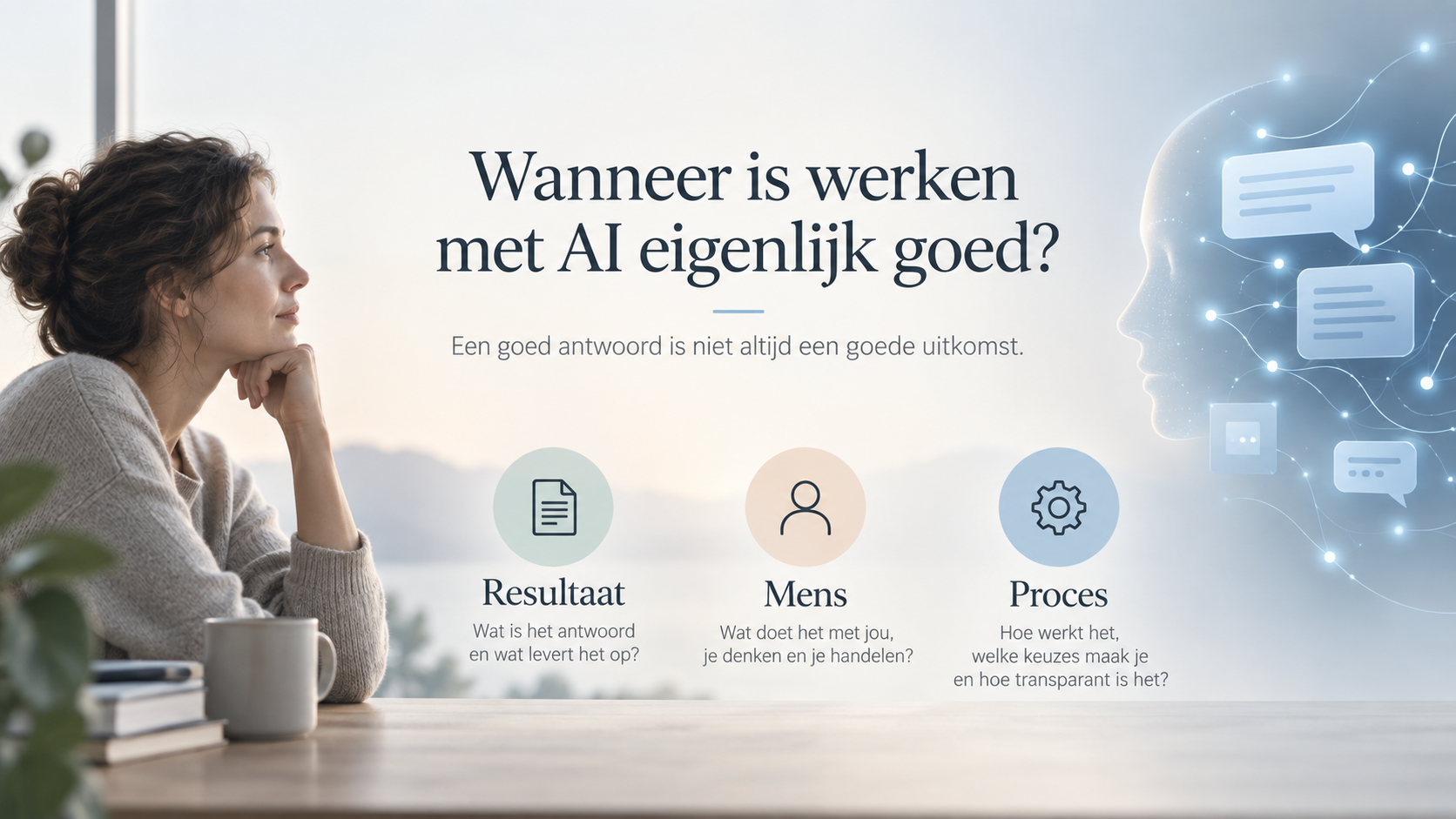
A good answer is not always a good outcome.
I now work with AI almost every day. To write, build software, explore questions and sometimes simply examine my own thinking.
The longer I work with it, the less satisfied I am with one simple measure:
Was the answer good?
Because that leaves a lot unsaid.
Lately, I notice my own way of working with AI changing. I accept answers less readily. I ask different questions. I explicitly ask for disagreement. Sometimes I let AI do something; sometimes I want to keep thinking for myself.
And increasingly, I try to understand why an answer emerges as it does.
That brought me to a different question:
What do you actually look at when assessing whether working with AI has gone well?
At first, it became far too complicated
You can explore this in considerable depth.
The model matters. ChatGPT, Claude or Grok may respond differently.
The history you have built with an AI may influence things. So may the available context, the budget you use, the quality of your questions and how much time you give a model to think.
All interesting.
But as we added more factors, the original question risked disappearing from view.
Eventually, three simple perspectives remained for me.
Result — what came out?
This is the most obvious one.
Was the text good?
Does the software work?
Is the analysis correct?
Was the advice useful?
Did it help someone make a decision?
For many simple applications, this is probably enough.
If I ask AI to improve a sentence grammatically, I do not need to reflect extensively on what that did to my development as a person.
Sometimes a sandwich is just a sandwich.
But once AI does more than perform a simple task, I find looking only at the result increasingly unsatisfying.
Person — what happened to the person using AI?
I now find this at least as interesting.
Did I understand more afterwards?
Did I learn something, or mainly receive a good answer?
Did I become better at something?
Or more dependent on AI to do it?
Did AI increase my curiosity?
Did I think more critically?
Or did I need to do less thinking myself?
AI can produce an excellent result while the user barely understands how it came about.
That need not always be a problem.
I certainly do not need to relearn navigation with a paper road map because my navigation system has taken over that task perfectly well.
But sometimes it does matter.
I am currently building software with AI’s help. Naturally, I want that software to work well.
But for me, learning to build with AI is part of the benefit too.
The best final product is therefore not automatically the best outcome.
Process — how did we get here?
Then something else remains.
How reliable was the route to the result?
What information did the AI use?
What assumptions were made?
Where did I need to check?
When did I intervene?
Do I understand enough of the reasoning?
And what happened when AI made a mistake?
That last one happened to me recently during a personal reflection.
AI filled in a small detail itself. The story sounded entirely logical.
Except I had never said it.
The interesting part was ultimately more than the fact that the answer was wrong.
I found this question much more interesting:
Why did that incorrect detail sound so plausible that I could easily have accepted it?
At that moment, the process became almost more interesting than the answer.
Three questions
I have no desire to turn this into a new AI framework, maturity model or matrix.
For now, three questions feel sufficient:
Result — What did it deliver?
Person — What did it do to me?
Process — How did we get here?
Not every AI interaction needs to be examined extensively through all three.
But as AI gains influence over how we learn, think, create and decide, I suspect the first question alone becomes less sufficient.
We currently assess AI mainly by what the system produces.
Perhaps we also need to learn to look more closely at what using AI does to the user.
And at the quality of the route by which an outcome emerges.
I do not yet know exactly where this thinking will lead.
That is also why I am writing it down.
What am I missing?
Do you recognise the distinction between result, person and process?
Have you ever received an excellent AI result but afterwards thought: I am not actually sure this was a good way to work?
Or are we making this more complicated than it needs to be?
I would be interested to hear.