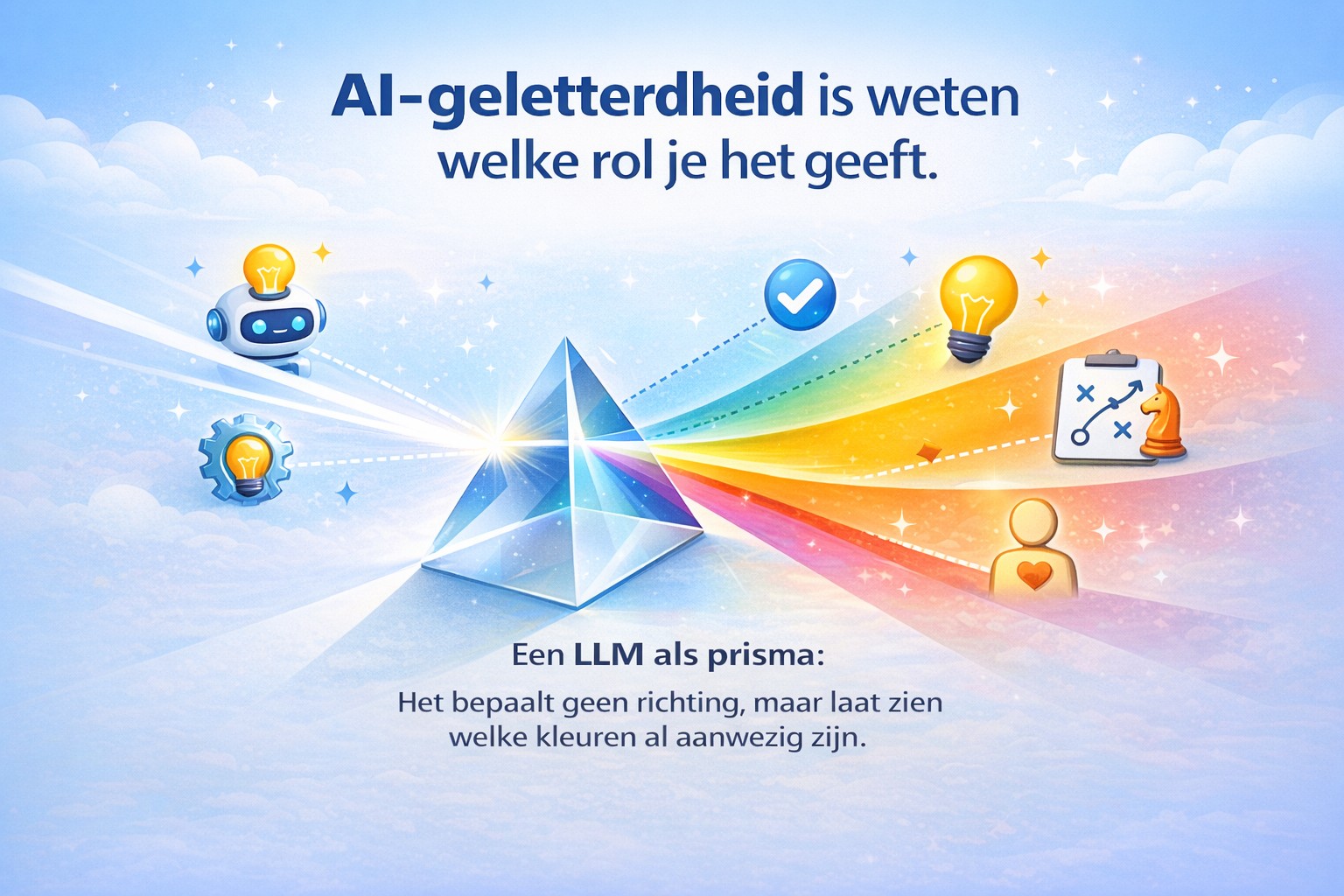
One model, two tracks — with an LLM as a translation prism
Introduction
You know the moment.
In an organisation: the strategy is clear on a single slide. Everyone nods.
Yet the meeting ends with inboxes, escalations and “just a quick task in between”.
In your own life: the intention is clear
(move more, make more things, live more consciously).
And three days later, you are back in the same place.
The problem is rarely a lack of intelligence or willpower.
The problem is translation.
Intention is often white light.
Everyday action is the world in colour.
If you only look at the logical colour, you miss why it does not take hold.
SEE — The prism: four colours of the same intention
Imagine your intention as white light.
It seems like one whole.
But once it has to pass through reality —
meetings, stimuli, relationships, tiredness, culture —
the light splits.
In my work, and in my knowledge base, I kept seeing the same pattern.
Everything clusters around four lenses:
- Mindset — direction, principles, choices
- Emotions — friction, shame, energy, safety
- Brain — cognitive load, attention, habits, systems
- Symbolism — rituals, language, signals, meaning
In many organisations, and with many personal goals, we act as though only one lens exists: Mindset.
We make it logical. We make it plannable.
But behaviour only emerges when the white light has passed through all four colours.
An intention that is only logical
is not yet liveable.
SEE — The four lenses, along two parallel tracks
1) Mindset — “What do we actually mean here?”
Organisational track
What principle lies behind the strategy?
Which trade-offs are real?
What does “good behaviour” look like concretely in teams?
Individual track
What is my principle?
What do I consciously say no to?
What does “good behaviour” look like in my everyday life?
Skip this lens and you get activity without a backbone.
Busy, but directionless.
2) Emotions — “What does this bring up?”
Organisational track
Where is resistance actually protection, rather than unwillingness?
Where is there a loss of status?
Where is there shame (“we should already be able to do this”)?
Individual track
What makes this daunting?
Where are perfectionism or fear of failure?
What provides enough safety to begin?
Skip this lens and you push harder with
“we just need to do this” —
and get withdrawal, cynicism or quiet sabotage.
3) Brain — “What does this cost in attention?”
Organisational track
How many choices must people make afresh every day?
Where is work too fragmented?
What friction is built into systems and processes?
Individual track
Where do I disengage in the moment?
What friction makes it hard — starting, switching, choosing?
Which choices can I standardise?
Skip this lens and it remains a good idea
that is difficult to put into practice.
It makes sense — but does not take hold.
4) Symbolism — “What are we making visible?”
Organisational track
What language do we repeat?
Which signals gain status?
Which rituals show this really matters?
Individual track
What small signal says: “this is who I want to be”?
What anchoring phrase helps?
What environment makes it visible?
Skip this lens and strategy remains text
while culture remains habit.
Intention remains a thought,
and behaviour a reflex.
DO — An LLM as a translation prism, with a clear role
An LLM is interesting here as a prism, rather than an advice machine:
a mechanism that consistently splits white light —
making what is missing visible.
The role is deliberately kept narrow:
- do not choose
- do not decide
- do translate
- do maintain coherence
Step 1 — Human
Formulate the intention in one paragraph.
- Organisational track: strategy in human language — what, for whom, why
- Individual track: a goal in human language — what, why, and also what is not intended
Step 2 — LLM
Have the intention translated through the four lenses.
To seek completeness,
rather than produce truth:
Where does it rub — emotions?
Where does it become heavy — brain?
Where does it stay invisible — symbolism?
Where is it vague — mindset?
Step 3 — Design for each track
- Organisation: lenses → epics → user stories, with a lens check
- Individual: lenses → 3 focus areas → 1 small experiment
Maximum 10 minutes to set up
This article concerns translation and design,
rather than a rhythm of reflection.
A concrete, reusable prompt
Role boundaries
You are a translation mechanism, not a coach or a decision-maker.
You do not choose for me/us.
You make things visible, identify assumptions and offer options.
Be brief and concrete.
Context
Context: Organisational track / Individual track
Example intentions — ready for the prompt
Use:
Choose one sentence → paste it under “This is our/my intention:” → let the prism do its work.
This is our/my intention:
[ Insert your intention here, or use one of the examples below ]
Example organisational intentions (3)
- We want risks to be voiced earlier and more honestly, so teams can adjust together before problems escalate.
- We want our strategy to become visible in everyday choices and priorities, rather than only in plans and presentations.
- We want quality to become visible in behaviour and decision-making, rather than only in documents and checks.
Example personal intentions (3)
- I want to focus my attention more often on making things, without my days being fragmented by reactive work.
- I want to start with behaviour I can sustain, without continually asking too much of myself or judging myself.
- I want to say no more often in a way that feels right for me, without continually having to justify myself.
Translation rules
- You do not decide
- You identify assumptions and offer options
- The output is brief and easy to scan
- Mindset
– 3 principles
– 3 trade-offs
– 3 examples of good behaviour - Emotions
– 5 tensions
– 5 conditions for safety/energy
– 2 shame triggers - Brain
– 5 points of friction
– 5 ways to reduce the load
– 3 choices to standardise - Symbolism
– 5 signals or rituals
– 5 anchoring phrases
– 3 things to stop
OWN — What AI cannot do, and you can
This is the turning point.
Why this is not an “AI takes over” story.
An LLM can make language consistent,
make gaps visible,
organise complexity.
But an LLM cannot own the consequences.
No responsibility.
No consequences.
No moral judgement.
SEE means using the prism to see reality in colour.
DO means choosing a design that makes it liveable.
OWN means leaving judgement, values and responsibility where they belong — with people.
From a Stoic perspective:
AI helps organise what can be organised.
Choosing and owning the consequences remain human work.
Closing
If you take away one thing, let it be this:
When intention does not take hold,
there is a good chance you are seeing only one colour.
Which lens do you — or your organisation —
skip most often?
Emotions?
Brain?
Or Symbolism, while mainly steering through Mindset?